Guide
Do Brain Supplements Work? What Health Agencies and Trials Say
Mostly, the evidence says no or not shown. NIH's NCCIH says direct proof that supplements prevent or treat dementia is lacking, and the National Academies called prevention evidence limited at best. No source we found tested VapoCept, whose seven lines run 7.5 to 200 mg.
Written by the VapoCept label deskUpdated
The short answer01
Do brain supplements really help?
For most of them, the research has not shown it. That is the plain finding from the main U.S. health sources, and it applies to supplements sold for memory, focus and clarity.
NIH's National Center for Complementary and Integrative Health says direct evidence that supplements prevent or treat Alzheimer's disease and other dementia is lacking (NCCIH, 7 things to know: supplements and cognitive function). A National Academies committee reached a similar view in 2017: evidence for prevention was "limited at best, despite the many claims of success made in popular media and advertising" (National Academies, Preventing Cognitive Decline and Dementia (2017)).
"Not shown" is not "proven useless". It means the trials were not done, were too small or came out flat.
The same question about the VapoCept capsule gets the same honest answer: we found no study of it. The detail is on our VapoCept benefits review.
What trials found02
What did trials find for well-known brain supplements?
NCCIH's clinical digest goes through the big names one by one. Most results were flat, and none of the products below is in the VapoCept panel.
| Supplement | What the digest reports |
|---|---|
| Ginkgo | A 2008 trial of over 3,000 older adults and two meta-analyses found no lower dementia rate |
| Omega-3 | A 2020 meta-analysis of 38 trials (49,757 people) found no cognitive benefit |
| Vitamin E | A 2017 Cochrane review (820 people) found no benefit |
| B vitamins | A 2018 Cochrane review (879 people) found no short-term benefit |
| Multivitamin | No clear cognitive benefit in well-fed people |
There is one more result worth knowing. A three-year multivitamin trial in more than 3,500 adults over 60 found better scores on one online memory test (NEI/NIH, Multivitamin and memory (COSMOS-Web)). That was a whole multivitamin in older adults, not an amino acid capsule.
The digest does not cover arginine, citrulline or beta-alanine (NCCIH Clinical Digest, Supplements and cognitive function: what the science says). For those, see our guide on arginine, citrulline and beta-alanine.
Marketing03
Why do brain supplement ads sound so sure?
Because a supplement can be sold without proof that it works. The FDA does not approve supplements for safety or effectiveness before they reach shelves (FDA 101, Dietary supplements).
A seller may describe how a nutrient affects the body's structure or function, but not claim to treat or prevent a disease, and the label carries a line saying the FDA has not evaluated the statement (FDA, Structure/function claims).
The FTC holds sellers to a stricter standard than the label does. It says a claim needs evidence about the finished product, and that a study of one ingredient may not carry over when the dose or the mix differs (FTC, Health Products Compliance Guidance). In 2017 the FTC and the New York attorney general alleged that a well-known memory product's claims lacked support (FTC, Prevagen's fishy brainpower claims). That case is cited only for what was alleged, not for an outcome.
How to check04
How can you judge a brain supplement label?
Use five checks. They take ten minutes and work on any bottle, ours included.
Find the printed amounts
Every ingredient should show a number. A bare list hides the dose.
Compare with the studied dose
Many amino acid trials use grams. Divide the label amount by the trial amount.
Match the trial to you
A trial in frail adults over 65 does not describe a healthy 35 year old.
Look for a trial of the product
A trial of the finished capsule is the real test.
Read the wording
"Supports" and "restores" are different claims. Neither is proof. Nobody endorsing it is not proof either (FTC, Endorsement Guides: what people are asking).
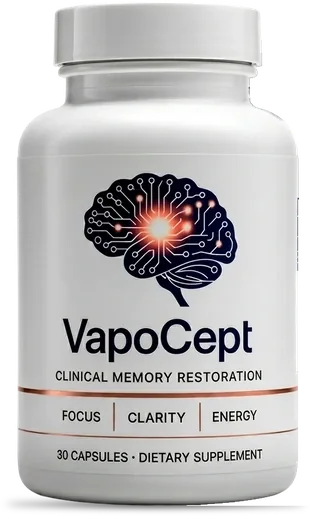
VapoCept: 30 capsules, 30-day bottleOne capsule a day · 2, 3 or 6 bottles · $49 to $79 a bottle per the brand information, confirm at checkout
See packsApplying it05
How does VapoCept measure up on those checks?
It prints seven amounts, which is a good start. It fails the later checks, because no study of the capsule exists and the studied doses are far larger.
The brand's panel, as listed (check your bottle), gives niacin 7.5 mg NE, calcium 18 mg, L-arginine 200 mg, L-arginine AKG 200 mg, L-citrulline HCl 100 mg, L-citrulline malate 100 mg and beta-alanine 40 mg. Studies of arginine, citrulline and beta-alanine use grams a day and measure blood pressure or exercise. The bottle's front reads "Clinical Memory Restoration" in the seller's words, and no source we found shows that.
Label amount vs research amount, log scale
-
L-Arginine (base)
5% of the low study amount200 mg4,000 to 24,000 mg a day in blood pressure trials; 2,000 to 20,000 mg in exercise reviews (Dong 2011, Oral L-arginine and blood pressure meta-analysis)
-
L-Arginine AKG extract
5% of the low study amount200 mg4,000 to 24,000 mg a day, the same arginine range; the AKG share of the 200 mg is not stated (Dong 2011, Oral L-arginine and blood pressure meta-analysis)
-
L-Citrulline HCl
1.7% of the low study amount100 mg6,000 to 8,000 mg a day (blood pressure and exercise studies) (Citrulline, perceived exertion and soreness meta-analysis (2020))
-
L-Citrulline Malate
1.7% of the low study amount100 mg6,000 to 8,000 mg a day; 8,000 mg of citrulline malate is the usual exercise amount (Citrulline, perceived exertion and soreness meta-analysis (2020))
-
Beta-Alanine
about 1% of the low study amount40 mg4,000 to 6,000 mg a day for weeks in exercise studies (NIH ODS, Exercise and athletic performance (health professional))
-
Niacin
47% of the adult RDA7.5 mgRDA 16 mg NE for men (14 for women); upper limit 35 mg a day from supplements (NIH ODS, Niacin (health professional))
-
Calcium
1.8% of the adult RDA18 mgRDA 1,000 mg a day for adults 19 to 50 (NIH ODS, Calcium (health professional))
Cyan marker: the amount in the brand's panel, as listed. Graphite bar: the range used in research (amber bar for the RDA up to the upper limit). Each step to the right is ten times more. A studied dose says what was tested, not what works for you, and no study tested VapoCept.
Each step to the right is ten times more. See the dose math page.
Better first steps06
What should you do about memory or focus problems?
See a clinician before you buy anything. Memory loss and poor focus can have treatable causes, and NCCIH says not to use supplements as a reason to postpone seeing a provider (NCCIH, 7 things to know: supplements and cognitive function).
- See a provider firstMemory loss can come from treatable conditions, so a supplement is not a reason to wait. Do not delay seeing a provider. (NCCIH, 7 things to know: supplements and cognitive function) (NCCIH, Are you considering a complementary health approach?)
- Ask about your medicinesSupplements can interact with prescription and over-the-counter medicines. Tell your providers about everything you use, and keep proven treatment going. (NCCIH, Are you considering a complementary health approach?) (NIH ODS, Dietary supplements: what you need to know)
- Read the evidence, not the adA national review called the evidence for preventing cognitive decline "limited at best, despite the many claims" in advertising. (National Academies, Preventing Cognitive Decline and Dementia (2017))
- Know what a real trial looks likeOne trial gave more than 3,500 adults over 60 a daily multivitamin or placebo for three years and found better scores on one memory test. It tested a different product in a different group, and says nothing about VapoCept. (NEI/NIH, Multivitamin and memory (COSMOS-Web))
- Short-term B vitaminsShort-term B-vitamin use has not improved thinking in older adults. (NCCIH, 7 things to know: supplements and cognitive function)
When it is urgent
- Sudden confusion or speech troubleNew confusion, slurred speech or trouble understanding words that starts suddenly.
- Face drooping or one-sided weaknessA drooping face, a weak arm or leg on one side, or sudden vision loss in one eye.
- Memory loss that disrupts daily lifeForgetting recent events, repeating questions, getting lost in places you know, trouble with bills or cooking.
- After a head injury, or after a new medicineNew thinking changes after a fall, a blow to the head or a new prescription.
- Get emergency care nowSudden stroke signs need 911, not a supplement. Chest pain, fainting or a racing heart after starting a supplement also needs urgent care.
Signs from (NCCIH, Are you considering a complementary health approach?) (FDA 101, Dietary supplements). This list is not complete, and a supplement is never a reason to wait.
Our guide on memory warning signs explains what to bring to the visit.
Safety07
Is it safe to take a brain supplement with your medicines?
Not automatically. Supplements can interact with prescription and over-the-counter medicines, so tell your doctor or pharmacist everything you take (NCCIH, Are you considering a complementary health approach?).
The arginine in VapoCept can lower blood pressure, so people on blood pressure medicine, nitrates or sildenafil-type drugs should ask first. People who recently had a heart attack should not use arginine. Our page on supplements and blood pressure medicines has the details.
Keep taking prescribed medicine. A supplement is not a drug.
FAQ08
VapoCept questions people ask
Do brain supplements work for memory?
Direct evidence that they prevent or treat dementia is lacking, according to NIH's NCCIH. A few single-product trials show small effects in specific groups. Check who was studied and which dose was used before assuming it applies to you.
Does Mayo Clinic recommend brain supplements?
We found no Mayo Clinic page recommending a brain supplement. Mayo's L-arginine page says arginine is not recommended after a recent heart attack and may lower blood pressure. Mayo does not endorse VapoCept.
Is a nootropic the same as a brain supplement?
Nootropic is a marketing word with no legal definition. It says nothing about dose or proof. The FDA and FTC jointly warned one nootropics seller in 2019 over disease claims and weak support.
Can a multivitamin help memory?
One three-year trial of over 3,500 adults over 60 found better scores on a single online memory test with a multivitamin. It tested a different product in older adults. It does not apply to VapoCept.
Are brain supplements safe?
Not automatically. Natural does not mean safe, and supplements can interact with medicines. Ask a doctor or pharmacist first, especially if you take blood pressure medicine, nitrates or blood thinners.
What is the best brain supplement?
We do not rank products. The better question is whether a trial tested the finished product at its printed dose in people like you. Few brain supplements can answer yes.
Sources (16)
- 7 Things To Know About Dietary Supplements for Cognitive Function, Dementia, and Alzheimer's DiseaseNational Center for Complementary and Integrative Health (NIH), 2026
- Dietary Supplements and Cognitive Function, Dementia, and Alzheimer's Disease: What the Science SaysNational Center for Complementary and Integrative Health (NIH), Clinical Digest, 2022
- Preventing Cognitive Decline and Dementia: A Way Forward (front matter and summary)National Academies of Sciences, Engineering, and Medicine, Committee on Preventing Dementia and Cognitive Impairment, 2017
- Multivitamin improves memory in older adults, study findsNational Eye Institute (NIH) research news, reporting the COSMOS-Web substudy, 2023
- Effect of oral L-arginine supplementation on blood pressure: a meta-analysis of randomized, double-blind, placebo-controlled trialsDong JY, et al. American Heart Journal 2011;162(6):959-965 (authors from general knowledge; the fetched page showed only the title, journal and results), 2011
- Effect of citrulline on post-exercise rating of perceived exertion, muscle soreness, and blood lactate levels: A systematic review and meta-analysisJournal of Sport and Health Science 2020 (authors not shown on the fetched PubMed page; Rhim HC et al. from general knowledge), 2020
- Dietary Supplements for Exercise and Athletic Performance: Fact Sheet for Health ProfessionalsNIH Office of Dietary Supplements, 2026
- Niacin: Fact Sheet for Health ProfessionalsNIH Office of Dietary Supplements, 2022
- Calcium: Fact Sheet for Health ProfessionalsNIH Office of Dietary Supplements, 2026
- Dietary Supplements: What You Need to KnowNIH Office of Dietary Supplements, 2023
- Are You Considering a Complementary Health Approach?National Center for Complementary and Integrative Health (NIH), 2016
- FDA 101: Dietary SupplementsU.S. Food and Drug Administration, 2022
- Structure/Function ClaimsU.S. Food and Drug Administration, 2024
- Health Products Compliance GuidanceFederal Trade Commission, 2022
- Prevagen's fishy brainpower claimsFederal Trade Commission, Consumer Advice, 2017
- FTC's Endorsement Guides: What People Are AskingFederal Trade Commission, 2025
Who wrote this09
Written and reviewed by
Pages built from the brand information, the brand's images and linked NIH, FDA, FTC and peer-reviewed sources.
Last updated . Read our editorial standards and how we check reviews. This website is the information site of Vapocepts, the U.S. stocking partner for VapoCept. It is not the manufacturer and it is not the sales page. We earn money when you buy through our order links.
Keep reading
More about VapoCept
U.S. stocking partner for VapoCept
Ready to try VapoCept?
Check your medicines first, especially blood pressure, nitrate or erectile dysfunction medicine, then pick a supply. One capsule a day; one bottle lasts a month. The checkout shows the live price and the guarantee terms before you pay.
- Secure checkout on the sales site
- 60-day guarantee (per the sales page)
- Ships from the U.S.